A Balancing Act between Cat-Piss and Berry - L’Artisan Parfumeur Mûre et Musc

When I first encountered Mûre et Musc, I thought it belonged to another world: fresh, fruity, green, and delicate. I also naively assumed it would be easy to replicate — just add some musk, maybe a specialty base like Dewberry, and that would be that. But perfumery rarely works like that. You need the right bed of musk, the right bridges, and the right balance between fruit and green. Mûre et Musc is the kind of perfume that sounds disarmingly simple on paper — blackberry and musk — but smells like a small revolution in practice. When Jean Laporte launched it for L’Artisan Parfumeur in 1978, this gauzy fruity musk felt radically modern, turning a soft red-berry nuance inside white musk into the star of the show instead of a quiet side note. Personally, I’m not usually drawn to fruity perfumes, especially recent fruity compositions that lean on oversweet, photorealistic, almost plastic effects, but Mûre et Musc has a freshness that comes from the tension between the kitsch and the repulsive — and that is exactly what makes it thrilling.
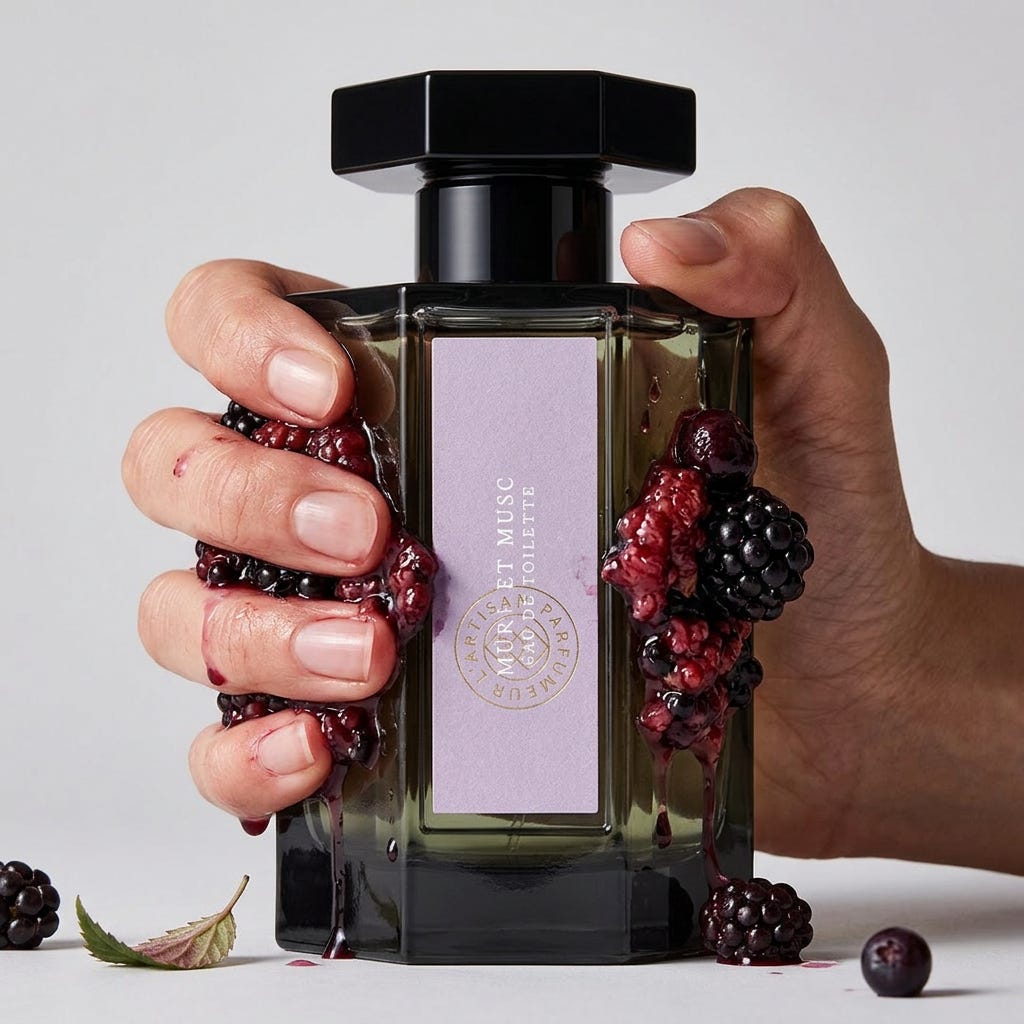
The origin story only deepens its charm. According to L’Artisan Parfumeur’s own history, Laporte first built a blackberry–musk accord that still felt imperfect, then carried it to Grasse to refine it with three perfumer friends — Jean‑Claude Ellena, Lucien Ferrero, and Jean‑Claude Gigodot — until the balance finally clicked. What emerged became one of the house’s defining signatures, and perfumers and historians still point to it as a milestone in the marriage of white musk and fruit. The formula here reflects that spirit of collaborative fine-tuning: a seemingly simple idea, executed through a long list of precisely calibrated materials. And while this reconstruction is not meant to be a 100% substitute, it is very much an homage.
What makes Mûre et Musc so interesting from a perfumer’s point of view is that there is no such thing as blackberry essential oil here; the fruit is an illusion, not an ingredient. In this composition, that illusion is built from a lattice of citrus and fruity materials — 4% methyl pamplemousse, 3.7% lemon, 3.4% sweet orange, 0.64% citral, along with gamma-decalactone, C16, pear ester, ethyl maltol, and ethyl 2-methyl butyrate — which together sketch a juicy, sunlit fruit rather than a literal berry syrup. The familiar blackberry impression is further supported by Cassiffix at 1.3% and raspberry ketone at 0.15%, giving a tangy red-fruit halo that sits between cassis, raspberry, and blackberry rather than naming just one fruit. Today, perfumers can also reach for naturals like cassis bud absolute and raspberry leaf absolute, but these bring a very different character: intensely fruity yet piercingly green, sulfurous, and leafy, closer to crushed stems and catty blackcurrant than to jammy blackberry. In a composition like this, it makes sense to lean instead on carefully dosed cassis-style molecules and modern synthetics to sculpt a cleaner, more transparent blackberry effect that aligns with the perfume’s soft musk identity rather than tipping it into wild green territory.
Anchoring this mirage is the generous musky backbone that gives the fragrance its softness, diffusion, and almost skin-scent quality. In my contemporary reconstruction of the accord, almost half of the formula is ethylene brassylate at 47%, supported by 12% Zenolide and smaller amounts of Edenolide and other soft white musks, creating a vast, diffusive cushion for the fruit to rest on. Ethylene brassylate is a macrocyclic musk known for its clean, powdery, slightly fruity-musky warmth and exceptional persistence, often described as the quiet clean-laundry musk behind countless modern fragrances. Zenolide and Edenolide extend this impression into a sheer, laundered, cottony veil, while Ambrocenide adds a touch of airy amber-wood radiance in the drydown.
Reviewers repeatedly describe Mûre et Musc itself as a clean, slightly soapy white musk with just a wash of berries — more an aura clinging to the skin than a loud, projecting trail — which was highly distinctive for its era.
Under that musk, I interwove a subtle collection of soft woods, including modern sandalwood-type molecules such as 6% Sandela, 2.2% Polysantol, and 1.6% Norsandyl. They add a creamy, milky warmth that keeps the composition from feeling too weightless. This quiet sandalwood hum echoes the soft woods in the base mentioned in archival reviews, grounding the airy blackberry-musk accord and giving it a faintly tactile, almost skin-on-wood texture rather than a purely abstract cloud of musk.
Around that backbone, angelica seed at 0.52%, tagette at 0.06%, and small amounts of galbex and beyond hivernal add herbaceous, slightly green and cool facets which stop the fruit from becoming sticky, while Clearwood and Evernyl in the base give a clean, modern patchouli‑moss structure without the darkness of traditional patchouli or oakmoss. As the perfume settles, this citrus–green halo dovetails with the berry heart and musk–wood base, maintaining a subtle tension between tart freshness and soft warmth.
What makes this reconstruction especially revealing is how much of this character rests on a handful of “hidden specialists” dosed in microscopic amounts. Labienoxime—also known as cassis oxime—is described by Givaudan and other suppliers as a powerful blackcurrant–grapefruit material with green, herbal, sage‑flower facets, created specifically to add a natural, fresh cassis lift to fruity and citrus accords at tiny dosages. In your formula it appears at just 0.02%, yet it sits alongside 1.3% Cassiffix and 0.38% galbex, where it can sharpen and naturalise the cassis–blackberry illusion without shouting its own name. Cassis pentanone, present at a mere 0.01%, is a sulfurous green blackcurrant‑leaf molecule so potent that it is typically recommended at extremely low levels, used to bring the metallic, leafy snap of blackcurrant bud to otherwise soft fruit or floral notes. Oxane, also at 0.01%, is an extremely strong fruity‑green top note, described as passion‑fruit and grapefruit‑like with galbanum and tropical nuances, particularly effective in citrus, exotic fruity and green compositions when used “in traces.”
Materials like these, especially sulfur‑containing cassis notes, behave almost like spices: at high levels they can become harsh or off‑putting, but at very low levels they unlock a vivid, mouth‑watering fruitiness and natural greenery that is impossible to get from broader brushstrokes alone. In the context of our Mûre et Musc‑style accord, Labienoxime, Cassis pentanone and Oxane don’t announce themselves as separate “notes”; instead, they sharpen the blackcurrant‑blackberry edge, add a wet, leafy coolness, and give the citrus–berry opening a sparkling, almost electric quality that makes the whole composition feel three‑dimensional. Their impact is amplified by the careful supporting cast around them: floral touches like rose crystals at 1.4%, beta ionone at 2.4% and PEA at 0.75% lend a soft violet‑rose glow, while lactonic notes such as gamma‑decalactone and C16 provide a creamy, pulpy texture to the imaginary fruit.
Seen from this angle, Mûre et Musc stops being a nostalgic “blackberry musk” and becomes a study in precision: a big, comforting musky framework animated by a few exquisitely chosen micro‑doses that set the faceting of the entire accord. Ethylene brassylate, Zenolide and their musk companions give the fragrance its long, quiet, skin‑like presence; the sandalwood molecules supply a creamy, almost tactile base; and the high‑impact berries, citruses and cassis molecules—especially Labienoxime, Cassis pentanone and Oxane—define the exact shade of blackberry we perceive. It is precisely this low‑tech, materials‑driven ingenuity—turning a modest musk structure and a handful of high‑impact traces into something iconic—that explains why the fragrance still feels relevant decades after its debut and continues to inspire both wearers and perfumers.
A professional formula can be purchased here.
Ethylene brassylate 47.00%
Zenolide 12.00%
Sandela 6.00%
Methyl pamplemousse 4.00%
Lemon 3.70%
Phenyl hexanol 3.40%
Sweet orange 3.40%
Beta ionone 2.40%
Polysantol 2.20%
Edenolide 1.80%
Linalyl acetate 1.70%
Norsandyl 1.60%
Rose crystals 1.40%
Canthoxal 1.30%
Cassiffix 1.30%
Styrallyl acetate 0.75%
PEA 0.75%
Clearwood 0.75%
Citral 0.64%
Plicatone 0.55%
Angelika seed 0.52%
Evernyl 0.40%
Beyond hivernal 0.38%
Galbex 0.38%
Delta damascone 0.24%
Gamma decalactone 0.23%
Prenyl acetate 0.21%
Carrot seed 0.18%
Raspberry ketone 0.15%
Ambrocenide 0.12%
Wormwood 0.12%
Ethyl maltol 0.08%
Pear ester 0.08%
Folione 0.07%
C16 0.06%
Tagette 0.06%
Ethyl 2-methyl butyrate 0.04%
Labienoxime 0.02%
Cassis pentanone 0.01%
Oxane 0.01%